Measurement
Part of Podcast advertising ROI UK: how to track response and attribution
Podcast advertising ROI UK: how to track response and attribution
Podcast advertising ROI UK: how UK advertisers track response with promo codes, vanity URLs, landing pages and surveys, and what to fix before launch.
What to take away
- Use promo codes, unique landing page URLs and post-campaign surveys together; one route on its own will mislead you.
- Tag every code and URL by show, host read and episode position so spend can be traced to a result.
- Test short codes and vanity URLs before launch, because a broken code spoils attribution for the whole flight.
- RAJAR MIDAS gives a reach estimate, while your own tracking gives the conversion figure.
- Cost per acquisition, not cost per thousand, is the number a finance director will ask about at renewal.
Why podcast ROI is harder to read than radio
Radio campaigns sit inside a medium with an official audience survey and decades of direct response testing. Podcast listening is split across apps, and much of it happens with the screen off. A listener who hears your ad on a walk might not act for days. That delay is why click data alone understates podcast performance.
RAJAR publishes MIDAS figures on digital audio listening, and buyers use them as a planning currency for reach. Treat that as the ceiling on how many people could have heard the ad, never as proof that they responded. Response evidence has to come from your own tracking.
Four routes to track response
There is no single source of truth for podcast attribution in the UK market. Most advertisers combine two or three routes and reconcile them once the flight ends. Four practical routes are:
- Promo codes:Give each show or placement a distinct code and record redemptions.
- Vanity URLs and unique landing pages:Use a memorable spoken URL or a dedicated page for each campaign, then record visits and conversions.
- UTM-tagged links:Add tracking labels to clickable links in show notes or podcast players, then review the resulting visits and conversions in your analytics. These labels cannot identify listeners who hear a spoken ad but do not click.
- Post-campaign surveys:Ask customers how they heard about you, and compare responses with code and web data.
For reporting, options include Podscribe for podcast attribution, Acast campaign reporting and Spotify Ad Analytics where available for the campaign. Check what the seller supports before booking; delivery or download figures are not conversions.
Four podcast attribution routes
Promo code
- Shows
- Show and episode
- Limitation
- Forgotten code
- Use
- Who acted
Vanity URL
- Shows
- Visits by show
- Limitation
- Needs short URL
- Use
- Conversion by show
Platform clicks
- Shows
- Immediate response
- Limitation
- Misses late action
- Use
- Digital response
Survey
- Shows
- Recall and intent
- Limitation
- Recall bias
- Use
- Who remembered
Run at least two routes side by side. A code tells you who acted; a survey tells you who remembered. Together they show whether a weak result came from low reach or a weak offer.
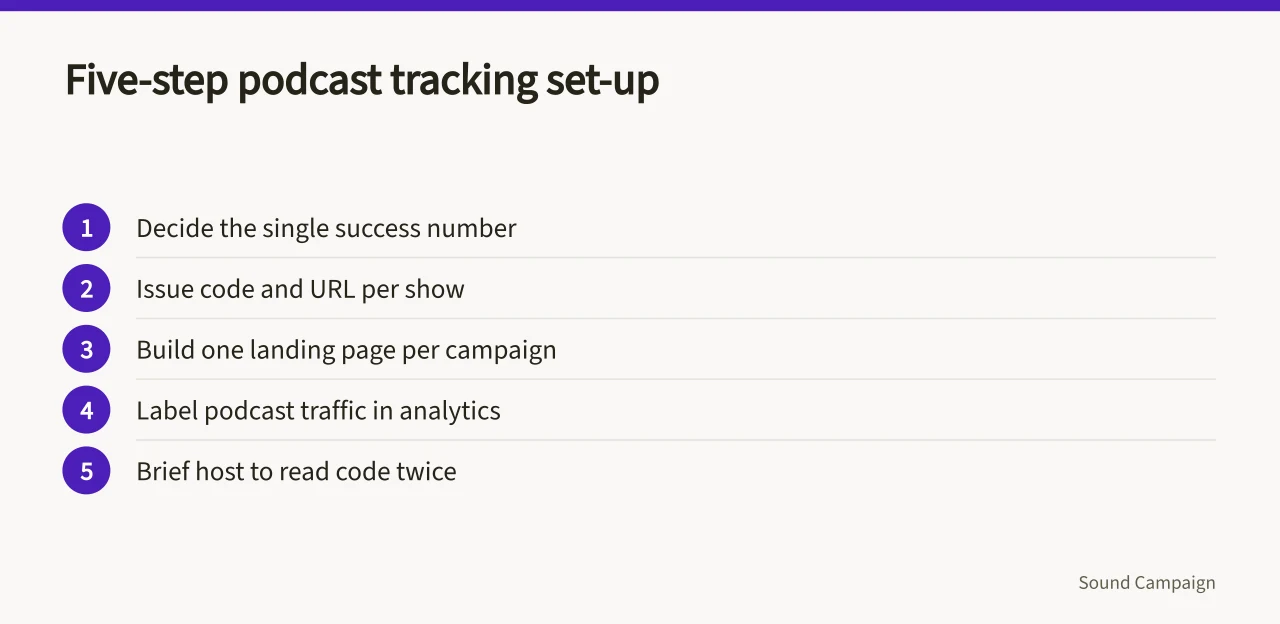
Build the tracking set-up in five steps
- Decide the single number that defines success, usually cost per acquisition or cost per redeemed code. If you use ROI, calculate it as (attributed campaign revenue minus campaign cost) divided by campaign cost, and agree how you will define attribution.
- Issue a separate code and vanity URL for every show, host read and episode slot.
- Build one landing page per campaign, repeat the offer in the headline and keep the form short.
- Label podcast traffic in your analytics so it is never mixed with paid search or social. For clickable links, use UTM parameters such as
utm_source,utm_medium,utm_campaignandutm_contentto identify the show, campaign and placement; review them in Google Analytics 4. Track spoken codes and URLs separately. - Brief the host to read the code twice, once early in the read and once at the close.
Agree the budget before you agree the tracking, because the cost of a show decides how much measurement effort is worth funding. Our guide to podcast advertising costs UK sets out typical rates per thousand downloads and per host read.
Reading the results without fooling yourself
Set an attribution window before launch, usually 14 or 30 days, and apply it to every channel equally. Podcast response skews late, so a seven-day window will flatter a search campaign running beside a podcast flight.
Seasonality distorts short campaigns. The ONS retail industry data shows how monthly sales move across the year, which helps you judge a quiet spell fairly.
If you collect email addresses on the landing page or match codes to customer records, you are processing personal data. The ICO's UK GDPR guidance sets out the lawful basis and consent rules that apply.
Any promotion must be clear and the advertising identifiable as such, as the CAP advertising codes require. Podcast ad rules follow the same code as radio, and our podcast advertising regulations UK article covers disclosure and host-read requirements.
Report a range rather than a single figure. Give the code-based number as the floor, the survey estimate as the ceiling, and state the assumption behind each.
Common questions
How long should I wait before judging podcast ROI?
Give every campaign at least 30 days after the final episode before you decide. Podcast response arrives late, and a shorter window will make the channel look worse than it is.
Are promo codes still worth using in podcast ads?
Yes, when each show gets its own code. A shared code tells you the campaign worked but not which buy produced the result, which makes the next negotiation harder.
What counts as a good cost per acquisition?
There is no market benchmark, because margin differs by category. Compare the figure with your paid search and paid social costs, then set the podcast target from your own gross margin.
Do I need consent to track attribution?
Not for aggregate counting of code redemptions. Consent applies when you collect personal details or link responses to named customers, which the ICO guidance above covers.