Foundations
Part of Before you commit a radio advertising budget, know the foundations
Where are the radio advertising commercial opportunities for media buyers?
A buyer's guide to radio advertising commercial opportunities, from airtime and sponsorship to podcast inventory, with a table for choosing between them.
What to take away
- The Communications Act 2003 received Royal Assent on 17 July 2003 and still frames the licensing of broadcast services across the UK.
- Most campaigns use one of four routesairtime spots, sponsorship and promotions, branded content, and online audio or podcast inventory.
- Broadcast advertising follows the BCAP Code and radio copy can be pre-cleared by the Radio Advertising Clearance Centre (RACC); online audio falls under the CAP Code.
- Rates and fees vary by station, format, timing and deal. This guide gives no rate figures, so request a current quote from the relevant sales team or platform.
Which radio advertising commercial opportunities can you book?
Airtime is the entry point. Stations sell spots in dayparts, and a breakfast slot in a busy market costs far more than an overnight one. You buy reach quickly, with no production lead time beyond copy clearance. For UK commercial inventory, buyers can contact Global's advertising sales team for Heart, Capital and LBC, or Bauer Media Audio UK's sales team for Absolute Radio, Kiss and Greatest Hits Radio. Ask about national, regional and station-specific availability.
Radio ad routes compared
Airtime
- What you buy
- spots in dayparts
- Lead time
- copy clearance only
- Cost driver
- daypart and spot length
- Best for
- fast reach
Sponsorship
- What you buy
- credits around content
- Lead time
- moderate
- Cost driver
- show association
- Best for
- borrowed trust
Promotions
- What you buy
- presenter-led minutes
- Lead time
- longer, needs sign-off
- Cost driver
- editorial approval
- Best for
- more minutes per pound
Sponsorship buys association rather than interruption. Credits around a show, a weather bulletin or a travel update keep your name beside content the audience already trusts.
Promotions and branded content sit between the two. A presenter-led competition or a short podcast series gives you more minutes per pound, but it needs editorial sign-off and a longer lead time.
Digital audio widens the field. Music streaming services, podcast networks and online radio sell inventory that reaches listeners well beyond broadcast schedules. Named buying routes include Global's DAX, Acast Marketplace and Spotify Advertising; ask about the UK podcast, streaming and online-radio inventory available for your campaign.
Spot length affects the rate. A ten-second tag costs less than a thirty-second spot in the same daypart, so match length to the message rather than habit.
Local and regional services sell smaller audiences at lower entry prices, which suits a test budget. National buys trade that flexibility for scale.
National, regional and local licence structures affect which services buyers can reach. Our [radio advertising market guide for England] sets out the England-specific picture; for UK licence records and categories, check Ofcom's published broadcast licensing records.
What decides price and availability?
Audience size sets the ceiling on what a station can charge, and daypart sets your position within it. Peak slots sell out first.
Seasonality matters more than many buyers expect. Retail and travel brands concentrate spend into predictable windows, which lifts rates in the weeks around them.
Deal structure changes the effective price. One spot costs more per thousand listeners than a volume commitment spread across several stations in the same group.
Production is a separate line on the quote. Some stations produce copy in house for a fee, while others expect a finished master from you.
Availability also depends on how far ahead you book. Campaigns tied to a fixed launch date need earlier reservation than always-on activity, and stations protect inventory for their largest clients first.
Group sales teams can cover several services in one conversation. For example, ask Global for a proposal across Heart, Capital and LBC, or Bauer Media Audio UK for one spanning Absolute Radio, Kiss and Greatest Hits Radio; available stations depend on market and audience. Compare a portfolio proposal with a single-station buy before you commit. Radio advertising demand signals in England explains where tightening supply is showing up.
How do you choose between routes?
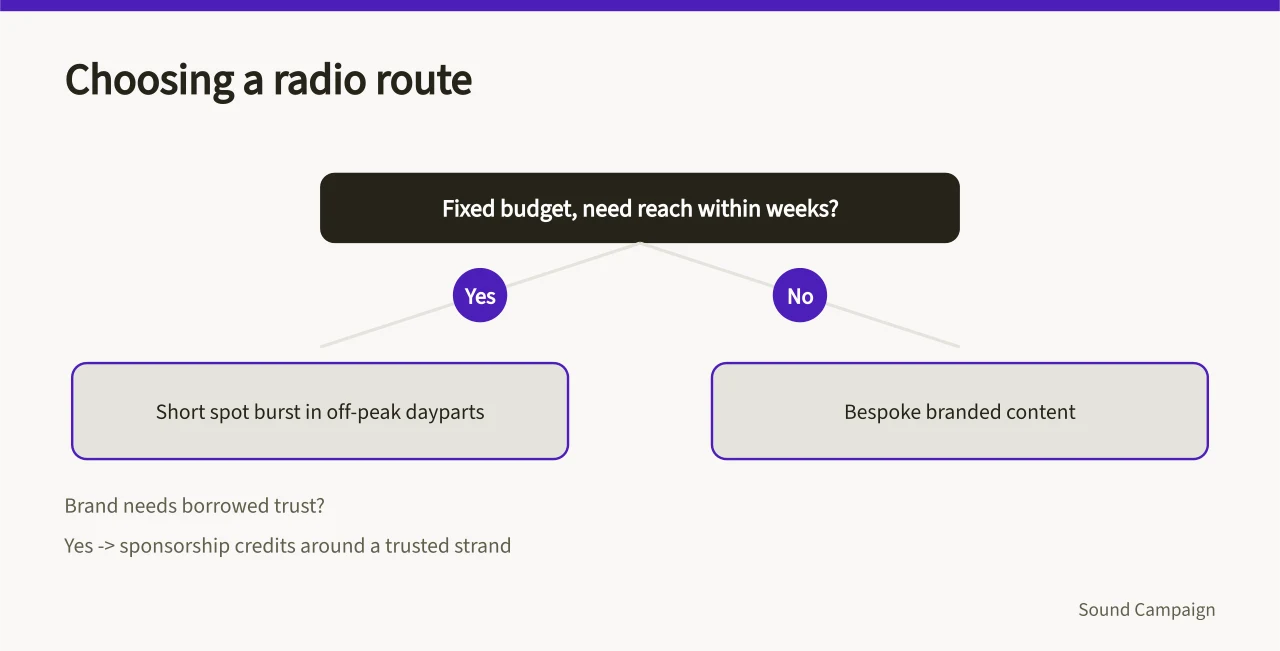
Match the route to the job you need done. The table below sets out the situations buyers bring to a station group most often.
Choose
- Fixed budget, need reach within weeks
- A short spot burst in off-peak dayparts
- Brand needs borrowed trust
- Sponsorship credits around a trusted strand
- Niche, digital-first audience
- Podcast and online audio inventory
- Regulated sector such as finance or health
- Pre-cleared copy with substantiation ready
- Multi-region launch
- A group portfolio deal across stations
Avoid
- Fixed budget, need reach within weeks
- Bespoke branded content
- Brand needs borrowed trust
- Scatter spots in sold-out peak slots
- Niche, digital-first audience
- Assuming broadcast clearance covers it
- Regulated sector such as finance or health
- Live reads agreed on the day
- Multi-region launch
- Buying every service separately
Routes combine well. A sponsorship strand can carry the branding while a spot burst drives response in the same weeks.
Whatever route you pick, ask for the audience figures behind the daypart rather than the station's total reach. A big station name does not guarantee a big audience in your slot.
How does regulation shape what you can book?
The BCAP Code (the UK Code of Broadcast Advertising) is the rulebook for broadcast copy. Use the Radio Advertising Clearance Centre (RACC) for pre-clearance before a commercial radio ad airs; stations can still refuse material that breaks the rules. Financial promotions, health claims and gambling carry extra conditions.
Clearance takes time, so build the approval window into your launch date. Keep substantiation for every claim, comparison and price you assert.
The CAP Code's non-broadcast rules apply to online audio and podcast ads, while the BCAP Code applies to broadcast. A campaign running across both needs separate checks: use RACC pre-clearance for radio copy and follow the relevant digital publisher's approval process for online placements.
Targeting and measurement carry their own duties. The ICO's guidance on artificial intelligence covers how personal data can be used when AI shapes who hears an ad or how response is measured.
Common questions
Do I need my own licence to advertise on radio?
The station holds the licence, not you. The Communications Act 2003 created Ofcom and set the statutory duties it applies to commercial radio services. Ofcom's published broadcast licence records let buyers check services and categories, including national and local commercial analogue radio licences and digital radio multiplex licences.
Is podcast advertising covered by the same rules as broadcast?
No. Broadcast spots follow the BCAP Code and can use RACC pre-clearance; online audio and podcast ads are covered by the CAP Code. A campaign across both needs separate checks, including the relevant digital platform's approval process for online placements.
Can AI tools be used to target or measure audio ads?
Yes, with conditions. Any use of personal data in targeting or measurement has to follow data protection law, and automated decisions carry extra obligations.
What should a first campaign include?
Start with one station group and one clear objective. Add a sponsorship strand only once you know the dayparts that deliver response.