
Rules and ethics
Planning Welsh radio advertising scripts in Cardiff
Plan Welsh radio advertising scripts in Cardiff with guidance on language mix, Welsh voice casting, script timing and checks before a spot is approved.
What to take away
- Radio advertising in Cardiff sits under two regulators at once: Ofcom, which licenses the stations, and the Advertising Standards Authority, which polices the content of the ads themselves.
- Welsh-language requirements bite hardest on public service and community stations, where licence conditions set out how much Welsh output is expected; commercial stations in Cardiff carry far less.
- The Welsh Language Commissioner does not approve individual scripts, but its standards and guidance shape how public bodies and their agencies commission Welsh-language ad copy.
- Cardiff's main commercial stations sell airtime by audience size and daypart, and Welsh-language spots are usually booked as part of a wider bilingual campaign rather than on their own.
Planning Welsh radio advertising scripts in Cardiff
Wales has two official languages, and that fact shapes radio advertising more than any single rule. There is no blanket legal duty that every ad broadcast in Cardiff must have a Welsh version. For script planning, decide whether the spot should be Welsh-only, English-only or bilingual, then consider the station's surrounding programming and audience.
What an advertiser needs to know is narrower. If you buy airtime on a station with Welsh-language output commitments, your spot sits inside a Welsh-language environment. Continuity, station idents and surrounding programming may be in Welsh, and an English-only ad can feel out of place to the audience you are paying to reach.
Public bodies in Wales operate under their own Welsh language standards, which is where the practical pressure comes from. A government department, a council or a health board running a campaign in Cardiff will normally expect Welsh-language creative as standard, not as an optional extra. Agencies working for those clients should price bilingual production from the outset.
Commercial advertisers have more freedom. A retailer, a car dealer or a restaurant can run an English-only spot on a Cardiff station without breaching anything. The reasons to add Welsh are commercial: reach, goodwill and the fact that a sizeable share of the local audience prefers it.
The rules that do apply to every ad, in either language, are the content rules. Misleading claims, harmful material and unacceptable comparisons are handled the same way in Welsh as in English, and the BCAP Code sets out those standards for broadcast advertising across the UK.
The comparison with advertising rules in England is useful here: the difference in Wales is language and licence, not advertising law.
Stations broadcasting from Cardiff and their audiences
Cardiff is Wales' media capital, and the station list reflects it. The city hosts national Welsh services, a cluster of commercial stations and community broadcasters, all serving overlapping audiences.
Cardiff station types compared
BBC national Welsh
- Examples
- Radio Cymru, Radio Wales
- Audience
- Wales-wide, mixed language
- Ad relevance
- Sponsorship only
Commercial national
- Examples
- Heart, Capital South Wales
- Audience
- Younger mainstream music
- Ad relevance
- Broad reach, English-led
Commercial regional
- Examples
- Nation, Greatest Hits
- Audience
- Older speech and music
- Ad relevance
- Local and regional
Community and specialist
- Examples
- Cardiff community stations
- Audience
- Small, tightly defined
- Ad relevance
- Niche and local traders
Stations broadcasting from Cardiff
| Station type | Examples serving Cardiff | Typical audience | Advertiser relevance |
|---|---|---|---|
| BBC national Welsh | BBC Radio Cymru, BBC Radio Wales | Wales-wide, mixed Welsh and English | No spot advertising; sponsorship only in limited cases |
| Commercial national | Heart South Wales, Capital South Wales | Younger and mainstream music listeners | Broad reach, English-led output |
| Commercial regional | Nation Radio, Greatest Hits Radio South Wales | Older, speech and music mix | Local and regional campaigns |
| Community and specialist | Radio Cardiff, Xpress Radio, Rookwood Sound | Small, tightly defined | Niche and local traders |
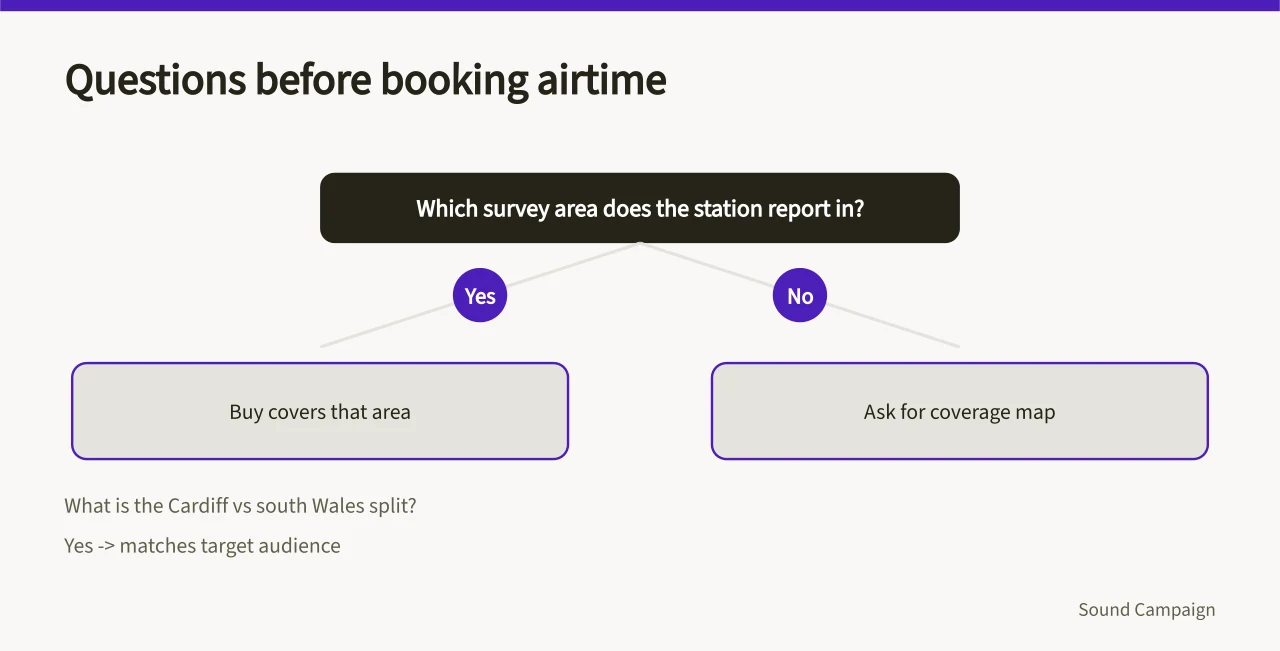
BBC stations in Cardiff do not sell spot advertising, so a commercial campaign will be built around the commercial operators. Those stations publish coverage maps and survey areas, and the RAJAR station mapping tool shows which survey region each Cardiff station sits in.
That matters when you are deciding whether a buy covers the city only or the wider south Wales belt.
Audience size is measured by RAJAR, the joint industry body for radio audience research. Its quarterly listening figures give reach, share and hours by station and by demographic, and those are the numbers agencies use to build a Cardiff schedule.
Read those figures with care before you compare the named Cardiff commercial stations. Heart South Wales and Capital South Wales report on the wider south Wales survey area, so their reach covers more people than a Cardiff-only buy would deliver.
Nation Radio and Greatest Hits Radio South Wales report on their own survey areas, which overlap Cardiff without matching it. A reach figure for a south Wales station is not a Cardiff reach figure, and the two cannot be swapped.
Community and specialist services are often too small to appear in the main RAJAR survey, so their audience is estimated from local data rather than measured alongside the commercial stations. Check whether a station subscribes before you rely on a published figure for it.
A word of caution on Welsh-language audiences. Welsh speakers are spread across the commercial stations rather than concentrated on one, so a Welsh-language campaign usually means buying a spread of spots and letting the creative do the targeting.
If you are unsure how your audience splits, the method in our guide to audience research for campaigns transfers directly to a Welsh buy.
Checking a station's Welsh-language output
Ofcom is the communications regulator for the UK, and it issues the licences that let a station broadcast at all. Its remit and published guidance are set out by Ofcom - GOV.UK, including the conditions attached to radio licences.
Those conditions vary by licence type. National Welsh services carry explicit Welsh-language commitments: quotas for Welsh-language programming, requirements around peak-time output and obligations to reflect Welsh culture and identity. For BBC Radio Cymru and BBC Radio Wales, those quotas sit in Ofcom's operating licence for the BBC.
Community radio licences in Cardiff often include Welsh-language commitments too, agreed when the licence was awarded. The wording for each station is published in Ofcom's broadcast licence register, so the commitment is checkable rather than assumed.
Local commercial licences are different. Their conditions focus on local news, local production and character of service. Some Cardiff commercial stations do carry Welsh-language programming, but where a licence spells out a commitment it sits in that station's licence document, read alongside the local news and production duties.
For an advertiser, the practical consequence is this. The station's licence conditions tell you what language environment your spot will sit in. If a station is required to broadcast a certain volume of Welsh-language output, its listeners expect to hear Welsh, and an advertiser who ignores that is paying for attention and then wasting it.
Licence conditions also drive format. A station with a strong speech and Welsh-language commitment will not suit a fast, music-led ad read, and a station built on chart music will not suit a long explanatory spot. Read the character of service before you write the script.
The Welsh Language Commissioner's role in ad content
The Welsh Language Commissioner promotes and facilitates the use of Welsh, and its standards apply to public bodies in Wales. The Commissioner does not vet individual radio scripts, and there is no approval step an advertiser must pass before a Welsh-language spot can air.
Where the Commissioner matters is upstream. Public bodies must comply with Welsh language standards covering service delivery, policy and communications.
In practice, that expectation flows down to agencies. If you are pitching a public sector client in Cardiff, assume the brief will ask for Welsh-language creative and that the client will want to show how it meets its standards. Building Welsh into the concept stage is far cheaper than bolting it on at the end.
For private advertisers, the Commissioner's guidance is a useful reference rather than an obligation. It sets the tone for what good bilingual communication looks like in Wales, which is worth reading before you brief a Welsh copywriter.
Producing Welsh-language radio copy: practical steps
Welsh radio ad copy fails for predictable reasons: too many words, awkward translation and a read that sounds like a language exercise. Work through these steps in order.
Producing Welsh radio copy
- Write English script, cut by a fifth
- Brief native Welsh copywriter, not translator
- Decide language mix and keep consistent
- Check brand and place pronunciations
- Cast Welsh-speaking voice artist
- Run quality checklist before approval
Producing Welsh-language radio copy
- Write the English script first and cut it by roughly a fifth. Welsh often needs more syllables for the same meaning, so a 30-second English script rarely fits a 30-second Welsh read.
- Brief a native Welsh-speaking copywriter, not a translator. Give them the objective, the offer and the tone, and let them write the Welsh version from scratch.
- Decide the language mix. A spot can be Welsh-only, English-only, or bilingual with a Welsh hook and an English body. Pick one and keep it consistent.
- Check pronunciation of brand names and place names with the voice artist before the session. Cardiff, Cymru and Welsh place names all have accepted pronunciations that listeners will notice.
- Cast a Welsh-speaking voice artist for Welsh lines. A fluent read and a learned read sound different, and the audience can tell.
- Run the finished spot against a quality checklist covering levels, timing, legal lines and pronunciation before you approve it. The items to tick off are the offer landing in the first five seconds, the Welsh pronunciation of brand and place names, the read fitting the slot length, audio levels matched to the station's technical spec, and any legal or regulatory line the client requires.
On suppliers, Sound Campaign does not recommend or take fees from any Welsh-language copywriting or voice-casting company. Ask the station's sales house which Welsh production houses it works with, or brief an agency that already writes Welsh radio copy, and confirm before the session that the voice artist is a fluent Welsh speaker.
A worked example makes the timing point concrete. Suppose your English script runs to 75 words and fills 30 seconds comfortably. A direct Welsh translation may run to 85 or 90 words and overrun the slot.
The fix is not to read faster. Cut the offer to one message, drop the secondary call to action, and let the Welsh script breathe at around 65 words.
Booking Welsh-language airtime in Cardiff
Cardiff airtime is sold in the same way as the rest of the UK commercial market. Stations and their sales houses quote by daypart, by spot length and by volume, and rates fall as the volume of spots rises.
Expect the usual daypart logic. Breakfast and drive command the highest rates because they carry the largest audiences. Off-peak and weekend slots are cheaper and often better value for a message that needs repetition rather than reach.
Sales houses do not publish rate cards, so ask for a cost per thousand listeners (CPT) for each daypart you are considering. A CPT lets you compare stations on equal terms, which a headline spot rate on its own does not.
Here is a worked example. Suppose your plan needs 300,000 impacts over four weeks in the Cardiff survey area. Multiply the CPT by 300, the number of thousands of listeners, and you have the media cost before any volume discount.
If the off-peak CPT is lower than breakfast, shifting spots off-peak buys more impacts for the same money. Ask the sales house to price the same schedule both ways and show you the mix, then compare the cost per impact.
Welsh-language spots are rarely priced separately. You are buying an audience, and the language of the creative is your choice. What does change is production: a bilingual campaign needs two scripts, two reads and two approvals, so the production budget is higher even when the media cost is identical.
When you request a schedule, ask three questions. Which survey area does the station report in? What is the split between Cardiff and the wider south Wales region? And can the station supply Welsh-language continuity around your spot? The answers determine whether your buy matches the target audience that buys from you.
Finally, book production lead time. Welsh copywriting and a Welsh voice session add days to the usual turnaround, and a campaign that misses its launch date because the Welsh read was booked late is an expensive way to save a day.